balance

A little switch to see things differently

wpid-2014-09-07-18.20.24.jpg.jpeg

This morning, I went to a yoga class and rolled my mat out in the same place I always do. It wasn’t until a good five minutes later that I realized that one of the women who is always behind me was instead next to me, to my right. That was different.

When the instructor walked in, she noticed the change immediately and said “I was thinking about perspective on my way over here and I was going to talk about something else, but now that seems less relevant.” I left an hour and half (and several sore muscles) later thinking about how a change in perspective is often at the heart of understanding someone else better. And with that understanding can come an insight necessary for moving past a difficult moment.

This week, what if we try changing seats? Maybe at a meeting meeting, or a class, or just sitting down in a familiar room: what would things look like from another place? Or from a seat next to someone you don’t know well. Or someone you don’t get along with.

I am a deep appreciator of habits, they help us get through the complexities of life in an amazing way. If I imagine all the things that have to happen in any given day – or week – to make it though, it’s overwhelming. From food to book bags to practices and events, we’d be lost without the small habits, like putting our keys in the same place (which I finally learned to do so recently I’d be embarrassed to tell you exactly when this became a habit!). We work so hard on the big habits, too, like exercise, eating well, work, college. Yet there’s value in shaking it up a little.

We’re delighted when there’s a small bump in the day, something different that marks it as special. The other morning I got up on a school day and made pancakes. They were from a mix, it wasn’t fancy, but it was fun and it surprised the kids (and me!). Yet in the business of our lives, it’s easy to pare down to the basics and be efficient about everything we possibly can. Including where we sit at meetings.

What will be different this week?


Are you ready to take it to the next level?

wpid-2014-09-01-13.53.49.jpg.jpeg

There are three killer hills at the end of my favorite bike ride and each one is bigger and steeper than the previous one. There comes a point, about two-thirds of the way up, when this phrase runs through my head.

You gotta put something into it to get something out of it….

It’s what gets me up the hills. I’ve talked to other people who ride bikes, and most cyclists have some version of this trick. It’s whatever gets you over the hard parts or up the last piece of the climb. Some people count strokes (“I’ll look up when I’ve pedaled 100 times”) some people go through the lyrics of a song before they look up. Whatever it is, it’s a way of marking the intervals in a difficult ascent.

I’m a strong proponent of having a life outside of work. It’s hard to do these days, when you carry your email around in your pocket and everyone’s sense of urgency is easy to absorb. Bicycling is a way for me to be out of touch for a while.

Interestingly, it’s often on a relatively flat stretch of road, while I’m watching the wind bend the grasses into rustling waves, smelling the cows and goats, and hearing the metallic ping of roof repairs on the nearby barn, that the answers to difficult questions appear most clearly.

I enjoy that feeling of calm, being out in the world, and working through things one wheel-turn at a time. With such emphasis on fast answers and immediate information, it’s easy to feel like success should also come in a click – like that good idea that pops out of nowhere. However, like a long bike ride,  we lay the groundwork for our larger ambitions and accomplishments in a million small ways. We have to put something into it.

How?

It helps to have some focus. I have a friend at work who said to me in jest, “my hobby is hobbies.” I knew exactly what she meant. I have a million interests and a million-and-one things on my to-do list at any given moment. It’s been difficult for me to learn to pare back to a more manageable inventory of “projects.” Instead of swearing off all projects, I instituted a simple rule: finish what you started. Or call it over and move on. I was overwhelmed by the number of projects and things I wanted to get to, as well as the things I’d started and didn’t really want to finish. Throw something off your to-do list. It’s liberating. I was not going to be a knitter. It bored me. No matter how many cute projects other people did. And just because I could knit didn’t mean I had to knit. So I donated my yarn and moved on.

Ask yourself: What old ambitions are you holding on to, even though they’re out of date? What do you really want to focus on now?

It helps to develop some habits to support your focus. I used to rush in the mornings to pull together lunches. I was pretty good at talking to my kids over the counter while they ate breakfast, but they weren’t getting my full attention and sometimes I’d forget to bring my own lunch (or wouldn’t have anything to bring.) So I’d plan to just deal with it sometime during the day. Of course, my days weren’t exactly conducive to pulling together impromptu lunches. In a pretty basic switch-up, we now make lunches during or after we make dinner. Note that I didn’t say I, I said we. Which brings me to the third, and most life-changing step for me.

What could you do to open some time for the thing you want to focus on? Can you stop doing something? Designate a time most days for your focus?

Ask for help. My kids are fully capable of making a sandwich, I just wasn’t asking them to. Once it became part of our evening routine, we were enjoying breakfast together and rushing less in the morning. It took more discipline on my part, at first, to ask for help and make sure it became a routine. Once the habit was established, we had an easier time of it. Having that routine set helped me focus on a more personal goal. My favorite time of day to write is first thing in the morning. In order to make that happen, I had to go to bed earlier, set my clock, and ask for help. My husband brings the coffee and gets up with me. His support of the habits I wanted to maintain has been the best motivator when I feel less than energetic (and that’s basically me, pre-coffee.). Find someone who has your back, wants to help you put something into it, and you’ll have double the oomph.

What are you assuming someone won’t help you with? Have you asked? What do you assume you cannot do? Why?

Changing something in your life can feel an awful lot like those last few hills of the bike ride. They’re big, they’re steep, and you’re tired. But each stroke of the pedal brings us closer. When I’m on the hill, the only thing I have to focus on at that moment is putting one foot down, then the other. All those movements together bring us over the top.

What gets you over the hills?


Why you should do your worst task first today.

“Eat a live frog first thing in the morning and nothing worse will happen to you the rest of the day.” – Mark Twain

wpid-2014-08-19-06.57.24.jpg.jpeg

I came across this Mark Twain quote last weekend and it struck a chord. One of the habits I have had to overcome (okay, I’m still working on it!) is procrastination through productivity. I’m mean really, nobody wants to eat that frog first thing in the morning, right?

Yesterday morning, I got to work at 7 am. I am not normally the earliest-arriver at my office. My philosophy is to be fully present and to work really hard while I’m at work – no coffee breaks, not too much chatter, focus on the work. That allows me to preserve time at home to be with my family and to have other interests. It doesn’t always work perfectly, but that break between work and home is important to keeping us motivated and fresh.

Yesterday was different. I had a few tasks that required my undivided attention at work and it’s summer. For one more week there are no busses, no evening meetings, no after school activities. Home felt cared-for.

So I went in – yawn – early, to eat my frog.

When you’re putting off that big project by doing a million little things, sending emails, filling, organizing your office instead of tackling that one big unpleasant task you need to focus on? That’s productive. But it’s still procrastination.

Here’s what usually happens. I finally decide to deal with whatever I’m putting off. I make time, I make myself do it, and when I settle in, I realize one of two things: 1) I’ve waited so long to examine the task that there’s something I’m missing and now it’s too late to get it/do a good job (this can sometimes result in a 9pm trip to the hardware store) or 2) It turns out that it’s much simpler than I had built up in my mind.

Lucky for me, yesterday’s task was simpler than I expected and I ended up having an hour to work, uninterrupted, on other projects. I felt centered and focused for the rest of the day which made me less stressed and more able to go with the flow of the day.

In our busy world, it’s easy to feel like our time and attention are constantly divided. There’s a lot of advice out there about how to structure your day and your time, how to disconnect, and how to focus. When we’re able to incorporate some of these skills into our planning, it can help us focus on what really matters.

Like frogs.


Mastery requires time. Where are you spending yours? And what are you mastering?

image

“Mastery is not something that strikes in an instant, like a thunderbolt, but a gathering power that moves steadily through time, like weather.”
― John GardnerThe Art of Fiction: Notes on Craft for Young Writers

I recently found this quote in a  book I’ve had on my bookshelf since the 5th grade. I underlined it sometime in the past ten or fifteen years, but it resonated in a new way.

We gather mastery over time, sometimes intentionally, sometimes by default.

We gather habits, reactions to conflict, ways of thinking, and behaviors along our way. In certain moments, we feel the satisfaction of getting good at something. Maybe it’s the thing people seek you out for, a talent you share, a way of listening. In other situations we wonder “why do I find myself here again?”

Either way, the gathering power is strong.

Gardner’s quote made me think differently this week. Where do I spend my time? What kind of mastery am I developing with my time?

It’s a great question when thinking about conflict. After all, conflict can be random, but there’s usually a storm behind the thunderbolt. It’s often brewing and gathering on the horizon and we can feel it coming. What are we doing along the way to manage it? Resorting to our usual, well-practiced reactions? Or can we try something different?

It helps to break the storm down and see if we can identify a point or two where we can practice a new technique.

  • If your style is to avoid conflict, it could be intentionally asking the person you’re avoiding a question.
  • If you hate answering phone calls and the weight of the “to-do” is robbing you of your peace of mind during the day, maybe you can answer them first thing in the morning.
  • If you’re hiding from a particular trouble, maybe you can find someone to air your anxieties with and brainstorm next steps.
  • Maybe it’s as simple as making a few minutes a day for an overwhelming and unmanageable (seeming) project?

It can be small because that’s the way mastery begins, as Gardner emphasizes.

I’m curious what kind of changes you’ve made in your approach in dealing with conflict. Were they small or storm-sized?


I think you should do this my way

wpid-1368714899045.jpg

At some point, we all find ourselves working with someone who is very organized, very thorough, and, not surprisingly, very successful at their job. This relationship can be wonderful – things happen, work gets done. But it can be challenging too, especially when they reach into your work and tell you how to do it. This type of overreaching can feel like micro-managing, or distrust, or an inability to let go. It can also bring out feelings of defensiveness and uncooperative behavior. Most of us don’t enjoy feeling bossed around.

It’s also common to play both roles, depending on the situation. Sometimes, we may be the one who “knows” how something should be done. Sometimes we’re the one on the receiving end.

On the receiving end, figuring out how to establish some boundaries is essential. Whether it’s a boss, a friend, family member or co-worker, some version of a firm stance may be in order. Especially when it seems that all the politeness in the world can’t get the message across.

I’ve witnessed plenty of blow-ups in these situations (or been the one blowing up), and it doesn’t do any good. The initial shock into silence can be a welcome relief. But it can also lead the overreacher to be further convinced of your inability to do things well and the cycle eventually picks up again.

The passive-aggressive approach doesn’t work either. Pretending that we’ll do things their way and then doing it our way is really only being aggressive in a different way. As a result, distrust builds and they may try even harder to reach in and control us next time.

How do we claim our territory without blowing our top?

  • It’s helpful to acknowledge the other person’s concerns. “I hear you’re worried about how I will present on this topic…..” This requires careful listening when we’d really rather fume about how they have no right to try to boss us around.
  • It’s important to tell them what you will or won’t be able to do about their concerns. This confirms that you heard them clearly and sets good expectations. For example, “I will reflect your concerns about xyz in my presentation but I will not be changing my information about abc from what you already saw.”
  • Tell them what to expect. Maybe, “I will share an outline with you before the meeting, but I won’t make additional changes at that time.”
  • Then stop.

I believe it’s important to be clear with others about your thinking, what you will do, and what they can expect as a result. I also believe it’s okay, when this person really is overstepping their boundaries, to have the self-respect to turn your attention to your work.

If you think you might be the overreacher, listening for these types of clues might be  a good place to start.

It’s a touchy situation, especially when the person you’re dealing with is someone you will have to continue to work with. Even when you think you won’t, I don’t recommend burning bridges. I’m sure others have found other ways to set boundaries with people who’d like to tell you how to do your job.

Do you think you do both of these? Neither? Do you have a suggestion?


Tug ‘o War

When was the last time someone handed you a rope and said “hey, how about you pull really hard on your end, and I’ll pull really hard on my end, and when one of us falls flat on our face, it’s settled. Okay?”

Eighth grade P.E. class, maybe?

For me, it was last weekend. Except it wasn’t a rope, it was an argument. The same stupid argument we have over and over. And nobody ever wins this particular one. we just pick up our ends of the rope, dig in, and start heaving our weight around. There’s a lot of mud involved and the emotional equivalent of strained muscles.

In the middle of all the pulling and tugging I wondered “Why do we keep tugging? Why not let go of the rope?”

Arguments can go wrong in so many ways when the emotions are high. We say things we don’t intend, we drag up battles of years past, we resurrect old hurts, previous slights, and the reasons to continue arguing pile up. But most of us don’t relish tug ‘o war and the repair cost can be high.

Some graceful ways to let go and buy yourself a little time to cool down without dropping your opponent (or co-worker, or family member) on their derriere.:

Take responsibility for your emotional state:

  • I’m getting (angry/frustrated etc.) and I need a few moments to calm down.
  • I want to come back to this discussion but I’m not thinking clearly right now, can we take a ten-minute break?

Own your role in what’s going wrong:

  • I’m starting to say things I don’t mean because I’m angry/frustrated/sad. Let’s take a break to calm down.
  • I think I’m being unfair because I’m feelilng (fill it in….). Can we take a break?
  • I know this is important to you and I want to listen carefully. I’m not able to do that right now.

For work-place situations:

  • I think you’ve made some good points and I need some time to think them over. Let’s schedule a follow-up conversation.
  • I’m going to need some time to consider this information. When can we get back together?
  • I can see this is important to you and I don’t have time right now to give it my full attention. Can we come back to it?

It’s very (very!) tempting to tell the other person all the things they’re doing wrong and enumerate all the reasons you can’t possibly have a productive conversation with them, but these kinds of statements probably won’t help:

  • You’re so unreasonable/irrational/mean/wrong that I just can’t talk to you.
  • You never/always …………(anything).
  • You don’t know what you’re talking about.
  • You should feel…..(any emotion)
  • Oh yeah? Well remember the time you did (this other thing that’s not related to the topic at hand but I’ve been dying to bring this up….)

Ideally, we wouldn’t get into these heated situations in the first place, but once it happens, putting down the rope until you’ve both had a chance to cool down and think things through can save a lot of struggle.

I’m sure there are many other great ways to stop fighting out there. What’s worked for you?


Launch the Week Right

File:Scout launch vehicle.jpg

When Monday gets launched right, it’s a pretty big deal. It’s easier to focus a lot of energy on managing your interactions during the week when you’ve taken care of some basics for yourself.

The weeks when I don’t get my house in order, when I feel like I splash head-first into work and don’t come up for a breather until late on Friday are the weeks I feel less productive, less healthy, and less of a positive contributor to my world.

Those are the weeks I lose my temper with my loved ones, forget to buy milk, fret about all the things I’m not getting done, and get backlogged at work.

Here are a few basic things you can do to give yourself an advantage at the week’s start:

1. Make a list of things you need to do this week. Friday is a great time to do this, right before you leave the office, or Sunday night, when you’re clearing your head for sleep, but Monday morning will do just fine. I am a big fan of the post-it note. Yes, smartphones rock. But they’re connected to all those other triggers that will distract you (email! calendar! photos of my sister’s little girl! Maybe I should buy some containers for my pantry! I can make endless lists on the note function!). Sometimes, the limited surface of a post-it note is a reassuring way to focus. It’s not so bad….

2. Do the worst thing on that list first. Do you need to make an appointment for something and you dread getting the robot menu? Need to fill out some paperwork for summer camp physicals? Have to draft an email to an irate co-worker? Take a deep breath and just do it. Then smile as you cross it off. It’s amazing how much better we feel when that’s out of the way, isn’t it?

3. Take stock of the week. Yes, this is also a good end-of-the-week habit, but if your life is anything like mine, by Monday morning you’ve probably already forgotten what you saw on Friday. Give your week a once-over. Do you have 2 commitments at one time? Have you allowed enough travel time? Did you schedule a meeting but forget to book a meeting space and tell everyone where to go? Take care of it now. Move it, cancel it, book the location, make sure you can keep your commitments during the week. By making sure you’re not setting yourself up to be late, harried, and disorganized, you will already be eliminating conflict from your life (and theirs!)

4. Bring your lunch. Really. Bring some food to work. I love to have a cup of tea during the day, so I keep several boxes of teabags in my desk. And microwave popcorn, some instant soups, crackers, fruit in a bowl on my desk, granola bars, some leftovers for lunch, whatever it is that will let you eat healthfully at work and say “No!” to donuts – whatever it is – make sure you’re bringing it with you on Monday.

5. Set a couple of priorities for the week and check them each morning. I like a post-it for this too. Right in front of my computer screen. I don’t have to go looking for them because they’re right there, all week long. The days can get crazy and you might not make it through everything on your initial list, but by having just a couple of realistic “to-do’s” you can cross them off and make progress. It’s nice to get to Friday and have something to show for it. In a world of endless distractions, focus is key.

There are a million helpful resources out there for time-management and priority setting, but these are the basics I keep coming back to week after week.

What works for you? How do you take care of yourself to be successful during a busy week?


Six years of recipes, and other project management thoughts

image

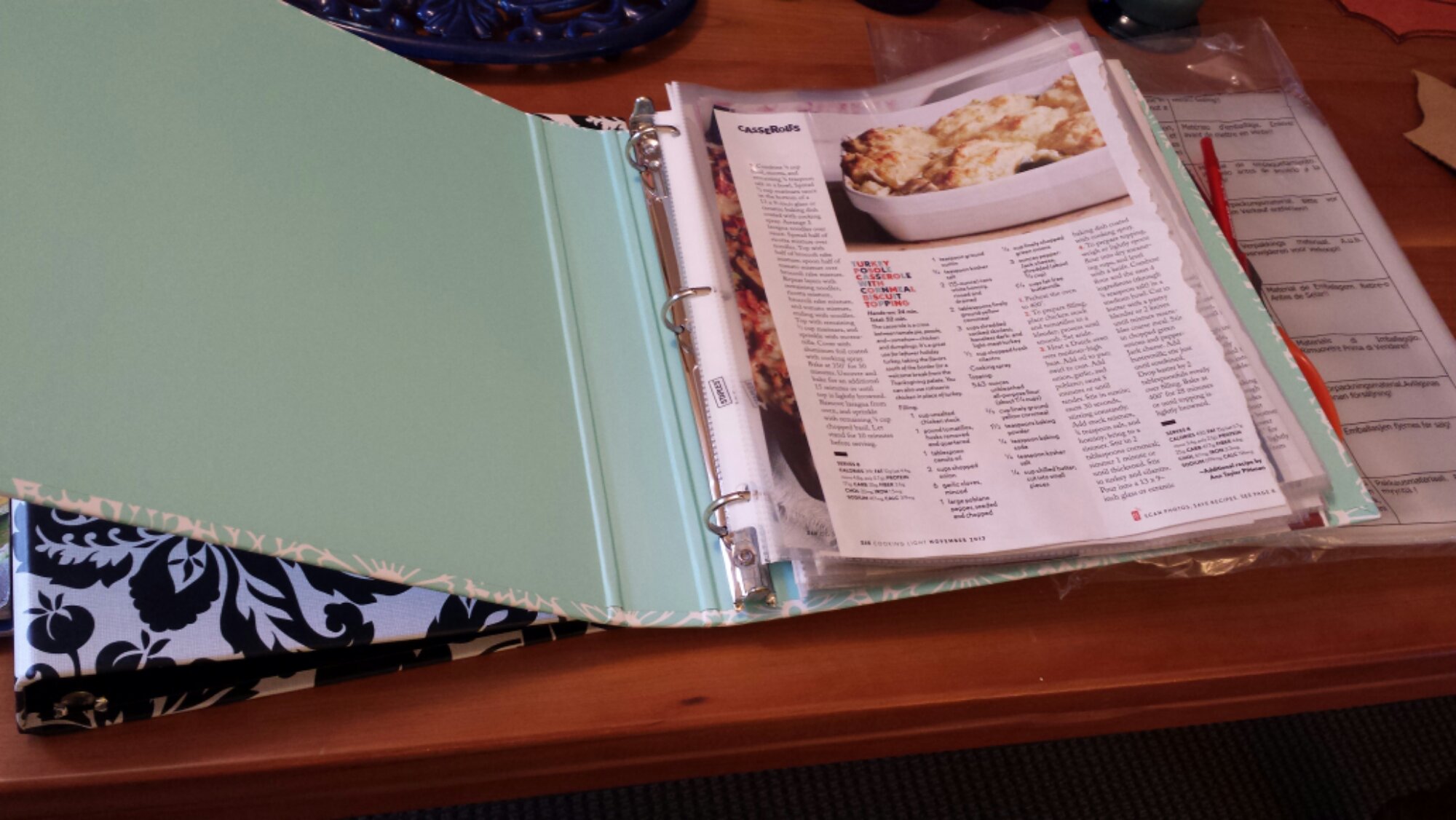
For some reason, I was hit by an obsessive need to clean out the six year accumulation of cooking magazines that had overtaken not one but two shelves of cookbook space in my kitchen. It’s not as if I’m awash in extra space anywhere in my house, especially in the kitchen! So, for a few weeks, I had a massive pile of plastic sleeves, torn pages, half-destroyed magazines and binders. Then, one day, voila: three binders, with tabs and recipes grouped in a way that makes sense to me. Cue the relief. Wouldn’t you know it, not two days later I opened my mailbox and found – you guessed it – a new cooking magazine. As I type this update, I know that there are at least two more in my pile of magazines in the living room. My lovely system will need – sigh – some maintenance. Of course, I suppose I could just pass those magazines along to someone else without adding to my binders.

I think part of the reason this project was so satisfying is that it was defined. I had a pile of magazines and I knew what I planned to do with them. Unlike a lot of our workplace challenges, I knew what was expected and had a clear outcome in mind. No conflict, no changing expectations, no wonder sliding recipes into neat, orderly plastic sleeves felt like a counter-stretch to the usual day.

Working on this project also gave me time to sort out a few idea about how to capture that sense of satisfaction at work.

1. Pick a project you’ve been putting off
In my case, it was the multi-year pile of magazines I’d been meaning to “do something” with for years.

2. Identify the beginning and the end of the project
I picked a day to start the project and described what the end would look like: no more magazines, all the recipes I wanted to keep organized in binders. I think the end is important because we often fail to be clear about where we stop. Sometimes that end point is a hand-off to someone else, in which case we need to be sure they’re on board with our plan. Sometimes, we fail to recognize the “maintenance” phase of a completed project. If we do that, it can fall back in our lap (see below).

3. Collect the resources you’ll need to complete the project
This involved a trip to my favorite office supply store where, armed with a clear idea of what I needed, I wasn’t distracted by the endless options. Same goes for work: a team of creative people can pile on the great ideas until you lose sight of your product. Having a clear list of resources and and end point can help you be flexible but firm in getting your project complete.

3. Set aside some time each day to work on your project
This can be the stumbling block. How many projects do you have in you list/head/space that you’re going to get to? And how many have a dedicated worktime on your calendar? I had to set aside time in the evenings to work on my project. I also kept all the supplies together in a bag (sleeves, binders, labels, markers, scissors) so it was ready to go when I was. Do you have a place for the materials and resources for your project?

4. Don’t give up before it’s done
We all do it. We get up a head of steam, we start, and we get distracted. If that happens, rededicate some time or space in your life to get the project done. If you’re really having trouble completing something, ask yourself if it’s still worth doing? If so, are you the right person to do it? If not, can it be crossed off the list? Sometimes choosing not to do a project is a good choice.

5. Know how you’ll maintain the results.
Will I cancel my magazine subscriptions? Or set a regular time to update my collection? I decided to let some of my subscriptions run out and to go through the sorting and collecting/discarding process a few times a year. If you don’t have a maintenance schedule, you may end up back at step one.

How do you make it through a project you’ve been putting off?

Strange Bird

image

It was chilly this morning when I left on my bike.  I wore a fleece jacket over my tank top and long-sleeved shirt and I still balled myself up into the collar as the wind cut through my layers all the way down the first hill.  Lucky for me, there are a lot of hills, both up and down, between my house and my office, so I quickly switched into standing-up mode and warmed right up.

I’m lucky that I have access to a shower and locker at work – without those I just wouldn’t do it – I also enjoy the feeling of calm and peace of mind at the start of the day.  It’s wonderful.  But I think what I like best is the serendipity of the sites along the way.

Today, I saw:

1. a smooshed snake (small, baby copperhead? hard to tell)

2. a wood thrush up close

and

3.  a guy crashing out of a Magnolia tree.

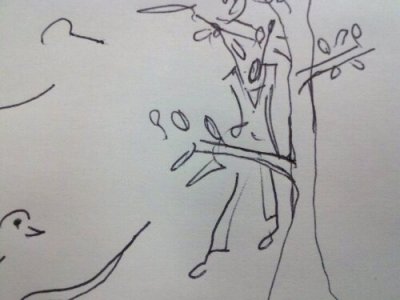
Yup – that’s right.  A fully grown man came tumbling out of a huge magnolia tree in the yard of a small, white house, breaking several branches on the way down if the sound of cracking limbs was indeed tree-related, as I was inclined to think since he landed on the ground and proceeded to talk rather calmly, given his recent descent, to someone I could not see.

I did see a stepladder nearby, the kind you might unfold in your pantry to reach the old can of camper-stove lighter fluid you stashed three years ago on the top shelf, but no other clues stick in my mental snapshot of the scene.

Explain it?  I can’t.  We just had college graduation yesterday and perhaps he was still…coming down off that experience?  Or maybe he too was inspired by the sunny, cool feeling of potential accomplishment that this morning held and was going to do some yard work?

All I know is I would have driven right by without noticing a thing.

I love riding my bike to work when I can fit it in, which isn’t very often given days that require multiple trips and the general pressures of grocery-dinner-extracurricular-kid life.  But I’m always glad when there’s enough breathing room in my world to pump up the tires and take off.

The bike ride is uphill both ways, but worth it.