effectiveness

Hello, Conflict Calling!

I’m not sure what possessed me to schedule a difficult one-and-a-half-hour conference call for first thing on a Monday morning a while back, but I did. And when we used the entire time and had to continue it into the three to five p.m. slot, I felt bookended by conflict.

There are a lot of days like this. A lot of weeks like this, aren’t there?

In this particular situation, we were going through a lengthy project topic by topic, sharing comments and points of view, which sometimes sounded more like “we won’t do this” and “well, we need to have this.”  Did I mention this was all on a conference call?

I put on my best listening persona and tried to really sink into the role of hearing what was important to both of us and listening for clues. I suppose the fact that it was Monday was ultimately helpful. I was reasonably well rested after a lovely weekend and able to step out of the situation a bit to notice the times when I wasn’t as focused or as effective. I noticed several situations that made it harder to communicate well:

  1. Several times it was clear to me that the other party hadn’t read or hadn’t understood the part of the document we were discussing. (Why do you keep saying things that aren’t accurate?)
  2. There was one instance when they were pushing for something we couldn’t do. I couldn’t offer what they needed; they weren’t hearing the base piece of information (not ours to offer) so I felt like we were in a one-sided argument. (Why can’t you stop asking about this? I can’t give you what you want!)
  3. There were times when I felt frustrated by the sheer number of follow-up items and stressed by the impending deadline. (How will we ever pull this together if you keep asking for more changes?)
  4. The conference call itself is sometimes a problem. In the absence of body language – poised to speak, mouth open, nodding – people tend to talk longer than necessary in order to get their point across in the void. (When will s/he stop talking so I can answer the question and we can move on?

The most humbling realization, however, was that the folks on the other end of the line were probably thinking the same things about me and my co-workers. There were some sections we’d suggested changing or adding that were covered elsewhere. I could tell that they, too, were nervous about making our deadline work, there were things we were pretty stubborn about, and I’ll bet you a nickle I talked too long at least once!

This evening, I was thinking about the whole situation and the great satisfaction I get out of solving complicated problems. I love this kind of work, but it’s not easy.

We all have to deal with work situations that are full of those moments of conflict. Listening carefully and just saying out loud some of those things in parentheses seems to help. It also pushes us to think empathetically – what’s going on with that other person and how can I reach them?

Here are some of the things I tried:

  1. Instead of “why didn’t you read this”, I tried “I know you just got this, do you need time to read it?”
  2. Instead of “I can’t do that” , we offered “Would it help to understand the relationship between these two pieces of information?”
  3. Instead of “We can’t keep adding to this list”, how about “We’re adding a lot to our list, perhaps at the end we should take a few minutes to discuss how we’ll get it done?”
  4. But that last one…..I’m still not sure how to get body language in a conference call, Skype, perhaps?

What are your tips for conference call negotiations?
Six years of recipes, and other project management thoughts

image

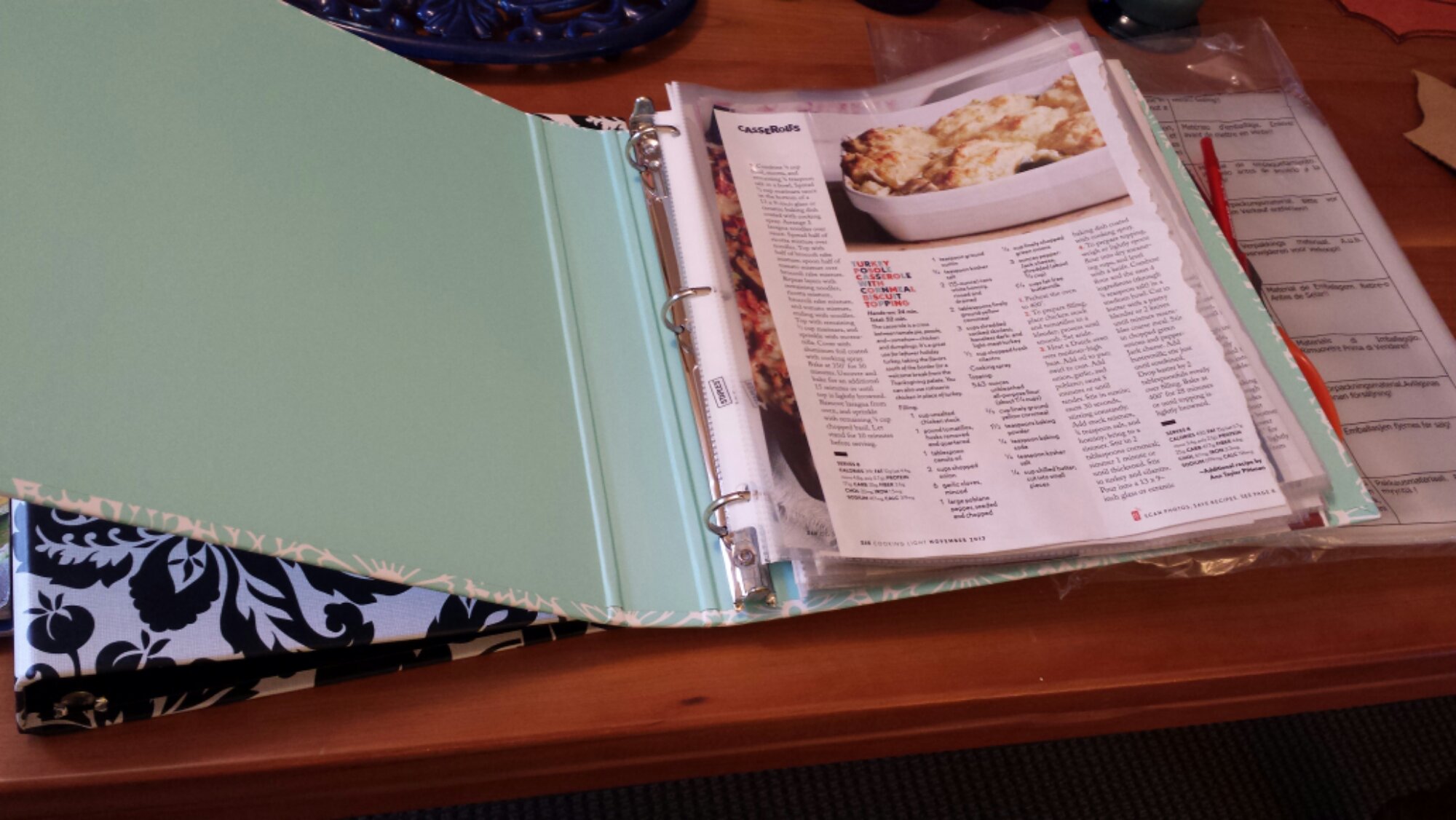
For some reason, I was hit by an obsessive need to clean out the six year accumulation of cooking magazines that had overtaken not one but two shelves of cookbook space in my kitchen. It’s not as if I’m awash in extra space anywhere in my house, especially in the kitchen! So, for a few weeks, I had a massive pile of plastic sleeves, torn pages, half-destroyed magazines and binders. Then, one day, voila: three binders, with tabs and recipes grouped in a way that makes sense to me. Cue the relief. Wouldn’t you know it, not two days later I opened my mailbox and found – you guessed it – a new cooking magazine. As I type this update, I know that there are at least two more in my pile of magazines in the living room. My lovely system will need – sigh – some maintenance. Of course, I suppose I could just pass those magazines along to someone else without adding to my binders.

I think part of the reason this project was so satisfying is that it was defined. I had a pile of magazines and I knew what I planned to do with them. Unlike a lot of our workplace challenges, I knew what was expected and had a clear outcome in mind. No conflict, no changing expectations, no wonder sliding recipes into neat, orderly plastic sleeves felt like a counter-stretch to the usual day.

Working on this project also gave me time to sort out a few idea about how to capture that sense of satisfaction at work.

1. Pick a project you’ve been putting off
In my case, it was the multi-year pile of magazines I’d been meaning to “do something” with for years.

2. Identify the beginning and the end of the project
I picked a day to start the project and described what the end would look like: no more magazines, all the recipes I wanted to keep organized in binders. I think the end is important because we often fail to be clear about where we stop. Sometimes that end point is a hand-off to someone else, in which case we need to be sure they’re on board with our plan. Sometimes, we fail to recognize the “maintenance” phase of a completed project. If we do that, it can fall back in our lap (see below).

3. Collect the resources you’ll need to complete the project
This involved a trip to my favorite office supply store where, armed with a clear idea of what I needed, I wasn’t distracted by the endless options. Same goes for work: a team of creative people can pile on the great ideas until you lose sight of your product. Having a clear list of resources and and end point can help you be flexible but firm in getting your project complete.

3. Set aside some time each day to work on your project
This can be the stumbling block. How many projects do you have in you list/head/space that you’re going to get to? And how many have a dedicated worktime on your calendar? I had to set aside time in the evenings to work on my project. I also kept all the supplies together in a bag (sleeves, binders, labels, markers, scissors) so it was ready to go when I was. Do you have a place for the materials and resources for your project?

4. Don’t give up before it’s done
We all do it. We get up a head of steam, we start, and we get distracted. If that happens, rededicate some time or space in your life to get the project done. If you’re really having trouble completing something, ask yourself if it’s still worth doing? If so, are you the right person to do it? If not, can it be crossed off the list? Sometimes choosing not to do a project is a good choice.

5. Know how you’ll maintain the results.
Will I cancel my magazine subscriptions? Or set a regular time to update my collection? I decided to let some of my subscriptions run out and to go through the sorting and collecting/discarding process a few times a year. If you don’t have a maintenance schedule, you may end up back at step one.

How do you make it through a project you’ve been putting off?

“Dreams are Just Dreams Without Action”

This quote, cut out from a fitness magazine, is stapled to the cork board in the back hall of our YMCA where I try to work out four days a week with my husband.

It’s pretty small, stuck there between the pseudo-army-crawl exercise and an article showing various power-snacks.  Small, but powerful.  I suppose the world is always sending you what you need, but sometimes you’re actually ready to see it.  Take this other quote I ran across a couple of days ago: “believing in yourself does not mean passively waiting for the universe to deliver what you long for.”

There is power in action.

Le Mot Juste

image

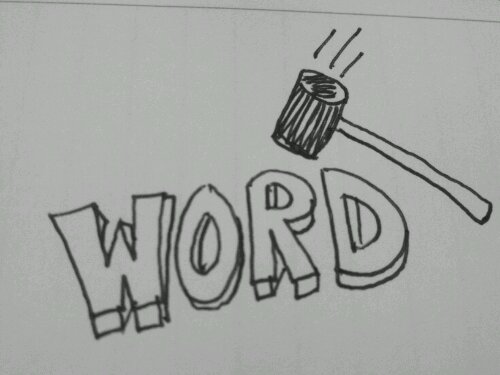
Flaubert would have been proud.  Today, I followed a committee discussion about principles, tracing their travels through language to find just the right way of capturing the way they wanted to describe and identify their future.  They were looking for le mot juste.  Each and every mot juste.  They pounded out the difference between promote and encourage, they explored the meaning behind some of the cliched phrases and jargon before them, casting old words aside for stronger, more precise words that accurately conveyed their aspirations.  It was both exhilarating and exhausting.

I have a hard time with writing by committee.  And yet it does have the potential to capture the broader world, when the participants are giving it their all, as these were.

This morning, I finished reading a New Yorker article by John McPhee in which he describes his use of the dictionary as a trail of breadcrumbs, moving from word to word until he stumbles across the gingerbread prize – le mot juste.

When the wisdom of a group produces something better than our individual searching – dictionary writers, copy editors, committee members, people who care – it’s a gratifying experience.

Between a …. well, you know

image

It’s pretty easy to see lots of my day’s interactions like this.  Whatever you call it, problem-solving or beating the proverbial head against the proverbial wall, it’s not fun.

Today, one of our best public speakers said he goes into presentations knowing he’s giving it his best – he’s prepared, he’s thought about why he’s there and what he has to share – but when things go sideways, he’s okay with that.  He doesn’t need his recommendation to be the only answer.

He’s right.  When you find that skinny space and slip out of the picture, it’s like having someone lift a load off your shoulders – or at least a few rocks.

The Inbox as Chinese Water Torture

image

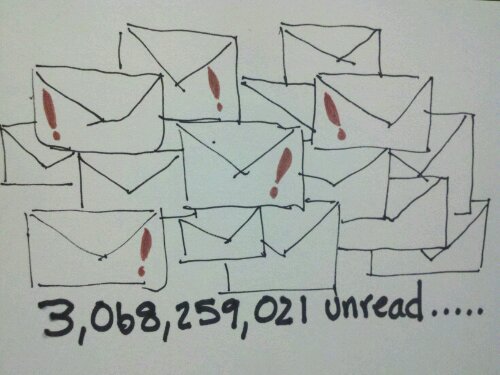
I’ve never actually had more than three billion unread emails, but close, pretty close.

It started so innocently….first one, then a few more, that thrill that you were needed,  you were connected, something exciting  was going on in your inbox.  Then – drip, drip, drip – they just kept on coming.  Daytime, night, weekends, vacation – drip, drip, drip.  And what seemed good or useful kept piling on until the Pavlovian reaction is less teenager-in-love-thrill and more make-the-torture-stop.

There was a point at the three-quarters way mark of a huge project last year that I actually did have 2,277 unread emails in my inbox.  Not three billion, but close, pretty close.

The first time I sat down to send an email, I had an address and a vague idea of what email was, but I had nobody to send a message to except my friend sitting at the terminal next to me.  We spent about 10 minutes there then headed out for food, coffee, people, something real.  I feel like I’ve been through the cycle of not having a use for email to email becoming virtually useless.  The important stuff is buried in the flood of newsletters, cc’s, people trying to schedule meetings through conversation instead of calendar, and the general chaos of people punting in the general chaos  that has more in common with a multi-team global soccer game with no rules than with actual communication.

Wikipedia lists “information overload” as the third problem with email (higher than spam, lower than limited attachment size).  So, what do we do?

In Germany, some lucky dogs at VW have their email blocked during non-work hours.  I think that’s better in some ways than trying to train ourselves to ignore, unplug, and ditch the habit between certain hours – but it’s really ignoring the real problem.

Email has become, in my opinion, fairly worthless but we lack a coherent alternative.  Maybe.  I see people opting out altogether (just a few brave pioneers, mind you) but maybe that’s the wave of the future.  Want to talk?  Pick up the phone.