Lost is a good place to start

wpid-2014-11-10-20.27.22.jpg.jpeg

If you don’t know where you are, or you’re not sure where you’re going, your navigation software isn’t going to get you there.

Most of us have something we’re supposed to be figuring out. Maybe it’s a career path or a difficult family situation. The searching can be frustrating and sometimes lead to shoving the whole project into our mental closet for sometime later when I have more time to deal with this.

It feels safe to know exactly where we’re going next, but when the path isn’t clear, the not-knowing can stop us from even taking the first step.

The Adjacent Possible

The adjacent possible is an idea borrowed from the work of theoretical biologist Stuart Kauffman and it is, basically, the concept that evolution happens at the edges of what is already happening. We can’t see ten or twelve steps down the evolutionary path, but we often can see around the edges of what we already know.

The idea is similar to what we do when we want to achieve a reach goal. If you’ve never been a runner but you decide to run a marathon, you probably won’t start by heading out for a 20-mile run. The first step is probably a jog around the block. With that first outing, you’ve stepped into the adjacent possible. With each step outward, you’re expanding your possibilities. 5K? 10K? Half-marathon? Marathon? Triathlon?

A lot of our work is more complicated than laying out a marathon training program because the variables are unpredictable. The Economy. Our co-workers. Changing work-place environments. Changing family situations. In many cases, we leap to a possibility’s fully-formed future and it seems unattainable (I could never do that) or we get overwhelmed by the things that could happen along the way (There’s no way to figure this out) and we stop.

Using the adjacent possible as a guide, and a mind-map as your guidebook, we can break a stretch into attainable possibilities. Notice I didn’t say “break it into steps.” More on that in a moment.

The Unattainable Goal

A single-celled organism didn’t become a Zebra overnight so if you want to be a Zebra, it helps to think backward. What’s in the world around your zebra?

Maybe you want a top-ranking position but you feel like your qualifications aren’t there yet and your experience isn’t sufficient. What would be close to your goal?

This is where a mind-map can come in handy. Jotting down all the experiences and skills that might be hovering around your goal gives you a world from which to map back to where you are now. Take a few of those next-to-your-goal ideas and map them out. You’re essentially after a treasure map, in reverse, leading to where you are today. When your backward mapping begins to contain experiences and skills you already have, you’ve have a map of pathways from today to your future goal.

Once done, it could look something like this:

wpid-2014-11-10-20.18.33.jpg.jpeg

The interesting thing about this map is that it will not show you a single path but a web of ways in which you might get to your goal. And the interesting thing about working towards our long-range goals is that both the path and the goal tend to change with time. So hanging onto that map and revisiting it to add new ideas and possibilities is a good idea. After all, each time you change your world, the adjacent possible changes with it.

The Unpredictable Goal

All goals are unpredictable but some are more wild and hairy than others. Our culture tends to reinforce the idea that success and progress are linear, measurable, and easy to map out. We want to list a series of steps, take them one-by-one and- voila! -results achieved. Everywhere we turn, we are bombarded by info graphics, predictive models, and performance measures. They can be very helpful but they can also create a sense of risk-aversion if you want to work towards something less numeric and harder to see. Something out there in the soup of future possibilities.

Let’s imagine a hurricane. When meteorologist are predicting where a hurricane will land, they use the cone of uncertainty.

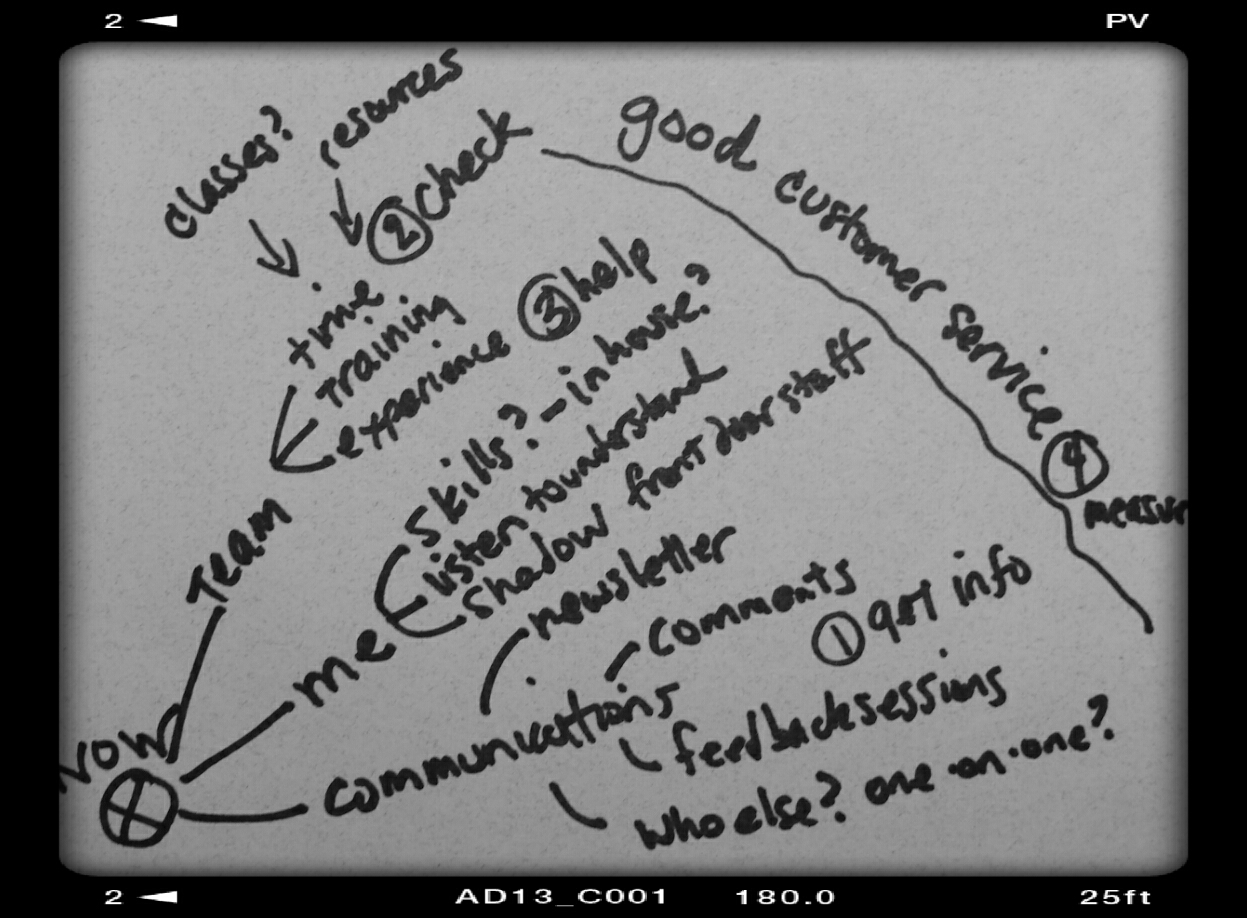
As the storm moves closer, their prediction is more accurate until we have landfall in real time. When you’re working toward an unpredictable goal, you’re pretty far off shore, and your cone is wide. The same exercise above, mapping out the adjacent possibilities, can help. In this case, however, you may be after a particular result – better customer service – and the path you establish could bring in new information that causes your target (your landfall) to shift. If you’ve mapped out a wide range of possibilities for your program, you can keep your eye on the main goal (landfall: improved customer feedback) and be flexible along the way (implementing new ideas that come from your feedback loop).

Your new cone/map of uncertainty might look like this:
wpid-2014-11-10-20.17.23.jpg.jpeg

The Missing Ingredient

All these exercises require the one thing that seems to be in shortest supply for everyone I talk with. Time.

We all rush around, checking email and feeling hounded by deadlines and the list of things you didn’t get don yesterday or the day before. Shoving our ideas into the corner is easier than setting aside the time to actually deal with them.

In order to do this, you have to find a way that works for you. (check out Gretchen Rubin’s video on forming habits by being true to your nature – it’s liberating)

Maybe this mind-mapping exercise doesn’t sound like fun in which case it might be your “frog” and you could try doing it first today.

Or maybe you relish the opportunity to daydream and doodle a little and you wouldn’t mind getting up early or spending your lunch hour alone someplace, undisturbed.

If you’re feeling like you don’t have the time at all, think for a moment about all the minutes you’ve already spent thinking about the fact that you’re not dealing with this nagging thing, and maybe the ultimate cost-savings will help you find the motivation to pull out your pen and get busy mapping.

You might find a treasure somewhere along the way.

Why you might want to do that really embarrassing, terrifying, or otherwise crazy thing you’ve been avoiding.

wpid-2014-10-14-22.15.08.jpg.jpeg

This evening, I did something terrifying and embarrassing. It was something I swore I would never do. Especially in public, where people would know. Wasn’t gonna do it. Nope. Not ever.

Then I did.

I sang. Out loud.

I know some of you are thinking “whaaaaa?? What’s the big whooping deal?”

Rewind the tape 30 years (ahem, maybe go back a few more) and you’d see me singing my little heart out about two rows back in the choir. Then, I got some coaching: “Why don’t you just mouth the words, honey?”

I was a pretty obedient kid, so I did. I got the message loud and clear. Until tonight.

If you’re still reading, and Hollywood and the internet have primed you for a late-in-life-rises-to-sing-on-stage ending, I’ll let you know right now that it’s not coming.

But here’s what I did figure out tonight, standing on the cool, grey stones outside, feeling the orange heat of an outdoor fire at my back and the early fall breeze stirring the paper in my hands.

Sometimes, you just have to let that old stuff go. The can’t, not good enough, don’t know how, never should’s. Really, who cares?

Do you even care anymore?

If you want to know how to do something, ask a teacher. We had an excellent instructor talk to us about the mechanics of singing. He reminded us that we all have the machinery, it’s a matter of learning to use it.

That’s a very powerful thought. We can probably each list a number of things we know we’re not good at. But if you’ve never learned how to do something, how can you be expected to do it well? Nobody every took the time to try to teach me to sing. They just told me I couldn’t. And the shame of it is I believed them. For a very long time.

We get second opinions on all kinds of things, we research our endless options on the internet, choosing just the right pair of shoes.

Then an offhand opinion pops up, and we take it as gospel. That makes no sense.

How much time did that tired choir director spend on her comment to me? Probably less than a second. But I’ve considered it truth since then.

Take that list of things you’re not good at and examine it closely. There are probably some things you really can’t do. I’m pretty short – there’s a reason I never made the basketball team. Several, actually, but that’s okay because I don’t really care.

Knowing what you care about is key. It lets you choose.

Once you figure out what you want to do, do it. A lot. We tend to live in the have-it-all-now-you-deserve-it world, but that doesn’t really work well. You have to find your passion then put your heart and soul into it, like this:

(TED talk) BLACK: My journey to yo-yo mastery

Maybe it’s no yo-yo mastery for you, yet once you have an area of focus, you can begin to say no to the distractions. We can’t do it all, or at least we can’t do it all well, in spite of what messages are out there.

One of my least favorite questions is “how do you balance it all?” because of the underlying assumption that we can or even should strive to balance it all. That’s not very humane, nor is it possible, in my opinion. So we have to make choices and when we choose the things we care about, when we build on a foundation of our strengths, we bring our best self forward.

Once you’ve made a choice, make the time.

I’ll be honest, I love to sing and I’ll keep doing it, perhaps to my family’s chagrin, but I’m not going to join a choir or take voice lessons, it’s not at the top of my list. Getting good at the top of the things on my list – some personal, some professional – is where I’ll be spending my time.

People say they can’t find the time to do something.

It’s not a matter of finding it, it’s a matter of making it. Making it yours, for a specific purpose, then respecting that choice enough to keep it.

That’s the hardest part of all, even harder than finding the right note.

A change takes courage.

I am still stunned that I opened my mouth and let the sounds come out. In public. But what shocks me even more is this: Nothing changed.

The world did not stop.

People did not clamp their hands over their ears and run screaming from the patio.

They just sang.

Suddenly, anything is possible.

Some really good singing and further discussion: Claron McFadden: Singing the primal mystery (TED Video)


Is the initial positive actually working against you?

wpid-2014-10-09-07.02.34.jpg.jpeg

Remember the initial positive?

First, tell them something positive, then tell them what’s wrong and conclude with another positive.

I’m sure it sounded like a good idea at the time. Especially for those of us who don’t really want to deliver bad news to people, it feels like a way to cushion the blow, from the messenger’s perspective.

But have you been on the receiving end of this conversation? It can feel something like this:

initial positive! “You’re doing great on the Kaboodle project, blah blah blah.”

(Right, you’re just saying all that because you’ve got some sort of gripe you’re about to unveil) 

here comes the bad news….“I think you could do better at managing your time on the KitandKaboodle project because….”

(Oh, so you think it’s my fault that Pat isn’t pulling his/her weight and now you’re blaming me. Great. I knew this conversation was really about that, and not Kaboodle)

and wrapping up with a positive! “But you’re making some good calls on the Zipperdoo project and I hope you’ll keep up the good work!”

(Yeah, until you assign Pat to that one too, then I’ll get the blame for slippage and it’ll be my fault again…)

Thanks!

(Thanks? All you did was tell me I was messing up the KitandKaboodle project.)

Okay, so that might be a bit extreme, but doesn’t some version of that happen when you’re delivering the positive-negative-postive sandwich? All the focus is on that middle piece and the positives are left to the side like unwanted bread crusts.

But a lot of us out there managing people were trained to do exactly this – and it’s supposed to make things better. Help the person you’re talking to see their strengths, talk about the things you should’t just sweep under the carpet, and then focus them on improvement in those areas with some assurance that you’re seeing the good work they’re doing.

Just tell me upfront

I had the chance to observe a couple of different exercises in the past month in which people were practicing a variation of this conversation.

Most of the time, some flavor of the sandwich was in play and sometimes the positives were so heavy the “employee” had no idea they had weaknesses.

By contrast, the most effective people put everything on the table at once.

“I’d like to talk about your excellent work on the Kaboodle and Zipperdoo projects and find out why we’re falling short of the schedule on KitandKaboodle. Which do you want to discuss first?”

When you’re going into a performance review, you don’t want to be surprised by what feels like a gotcha negative in the middle, do you?

Transparency

Transparency might be the latest buzzword, especially if you work in government at any level, but it’s a key factor in this scenario. By getting the sandwich ingredients on the table, it puts you in a position to work together on the assembly. Maybe the person you’re talking with needs to be able to discuss the positives first, maybe they’d rather get that biggie off the table first, but you won’t know if you don’t ask. And if you ask, you’re treating them as a partner in the conversation.

There’s a lot of research and practical information available about how to handle the rest of the conversation, but ditching the initial positive might be a simple first step.

Here are a few resources I’ve used – I’d be curious to know of others people find useful:

Difficult Conversations: how to discuss what matters most

Smart Leaders, Smarter Teams: How you and your team get unstuck to get results

Ask for it: How women can use the power of negotiation to get what they really want

Who moved my lunch?

wpid-2014-09-26-07.00.51.jpg.jpeg

Lunch-meetings!

Lunch-and-Learn!

We’ll provide pizza!

Brown-bag-seminars!

Oh, you think you’re busy and dedicated? We’ll I’ll see you a full calendar and raise you a lunch: “Well, I’m free at noon….”

Is lunch under attack? For a long time, I’ve made it a habit not to schedule lunch meetings, or expect them of others, four days a week. If I stay at my desk, I will work, I will answer questions, I will dribble food on my keyboard, and I will go home to my family and be crabby and exhausted. So I take lunch at the gym. I do reserve one lunch a week to spend as I choose. While there are  a few people who trump my no-lunch-meetings rule, that list is short.

Gym-lunch started out of necessity for me. With kids and a busy job, it was the only time of the day I could consistently exercise. But here’s the really neat part: I’m not the only one. I see a lot of familiar faces and co-workers there, and they’re all pretty awesome workers. I keep my workouts short, eat a quick bite when I get back, and we’re off to the afternoon!

I have a theory about this – the midday workout gets you refocused, gets you through the afternoon slump (often without coffee!) and even if nothing else goes well that day, you’ve done something good. Kind of like making your bed first thing in the morning.

Over time, it’s become easier to just stick with this habit instead of constantly looking for time to exercise in a schedule that doesn’t easily make room for anything “extra”. In theory, it’s pretty easy to establish this kind of habit.

1. put it on your calendar

2. respect the time

It’s the second one that’s hard. Having a workout partner helps a lot – someone who’ll be expecting you, on time, who will be late for something else if you let “just one more task” creep into your designated time.

Finding a research partner, a reports partner or someone who’s trying to make time for something compatible with your goal could help make anything routine – the key is that the other person’s habits will affect yours, so choose your partner wisely.

As for lunch, I believe our workplace sets the tone for a lot of our activities – after all, most of us spend more time at work than anywhere else – so what habits are you cultivating at work and are they contributing to an effective workplace or a stressed-out workplace?

You delegated and they didn’t deliver. What now?

wpid-2014-09-15-06.51.02.jpg.jpegIt’s three-o’clock.

Your to-do list is twice as long as it was when you started out this morning. You’ve been interrupted twenty times, the email is piling up in your inbox and you’re dealing with more emergencies than an ER. You’re about to throw your computer out the window and head to Belize where opening a bar on the beach seems like a solid next step in your career. Then the employee you just handed a project off to this morning – the project you actually delegated – shows up in your doorway.

“I’m not sure what to do about….”

“Just handle it!” you bark.

Things just got worse.

Delegating well is a skill and like any other skill we can get better at it.  Receiving a project well is also a skill and it’s one we talk about less. They’re the two sides of working together and they’re worth looking at side-by-side.

Handing off an assignment requires three basic things:

1. Clarity

“Just handle it” obviously doesn’t cut it. If you find yourself giving this kind of guidance, you may already be in steps 2 or 3 and a quality conversation with your employee is probably in order, so feel free to jump ahead.

If you’re taking the plunge, set aside enough time to hand off a project so you can be sure to cover the specifics. What are you asking this person to do? What is the deliverable? When should it be complete? How will you be available for questions along the way? Take the time to really listen to them at this point because their questions will signal whether they’re prepared, need some help, or might benefit from a conversation with someone else who has done this type of work before.

You want to challenge and grow the people around you, but throwing them in the pool without any swim lessons is not usually the best way to do that.

2. Communication

Be present during the project. They may have questions. In fact, the first time around, you probably hope they’ll have a few questions. Likewise, you may want to know how things are progressing on a longer-term project. What do you need from them so you won’t arrive at different destinations three weeks from now? Nobody wants to generate a crisis at the last minute because you thought they were doing X and they thought you wanted Y.

Establish some agreement about checking in.

3. Closure

After the project is over, we usually rush on to the next one without half a moment’s pause. That’s a missed opportunity. When someone’s done a good job, tell them. And try to be specific. Did they do something creative that you didn’t originally ask for? Let them know. But don’t just focus on the good.

Have the difficult conversations too.

Did they deliver something that was less than you expected? They need to know. They can’t guess where they didn’t meet your expectations and, if they’re consistently falling short, you need to address that. If you set good expectations at the beginning, you have something to work with. Going over those specifics and comparing your directions to the deliverable is an important step. It will also challenge you to see your instructions from the other side.

Did you really tell them what you thought you did?

Were you clear about the format? The schedule? The content? If so, it should be in writing somewhere from your handoff. If not, you may want to focus more on that step next time.

Receiving a project well is the mirror image of good delegation:

1. Clarity

Are you able to do the project as described? If you have other projects on your plate and you’re worried about time, speak up. It’s not whining to say “You’ve asked me to do these four things. I’d like to work on this project too but I need some clarity about deadlines. Do you have a sense of priority or can I review all five and get back to you with some suggestions? Do you have a top priority?”

Do you actually know what’s expected of you? For some people, this is easy. Maybe you’ve done this type of project before and you have an instant sense of what it’ll take. But when we’re getting something new, it can be hard to really know. In those cases, it’s helpful to find someone who’s done this type of project, run through the steps with them, ask lots of questions and get clear. Then double back with your supervisor with any questions about the direction you’ve received.

2. Communication

If you’ve been asked for updates, share them. Take the time to understand how your supervisor wants to hear from you. Do they like the drop-in? Do they prefer an email? If you don’t know, ask. “I want to make sure you know how things are going, how would you like to receive updates? And what’s the best way to check with you if I have a question?”

If you’re on the receiving end of “Just handle it!” take a step back.

Is it you? Did you catch them at the wrong moment? Did they say they prefer email updates and you’ve dropped by three times? Are you trying to let them know your progress but making it sound like a question? Are you stalling because you’re not confident in your next steps?

When you took on the assignment, your supervisor was probably hoping you’d step up and be part of the team. They may also be nervous that they’ve delegated part of the work and that you won’t follow through and they’ll end up doing it anyway. Take an honest moment to ask yourself if you’re doing everything on your part to make this project a success.

Is it them? Does this happen to you frequently with this person? Are the directions so vague that you really don’t know what’s expected of you? Is this something new you don’t understand? If so, revisit step one. Find the right time and method to tell them your goal is to deliver what they need on time and to do so these are your questions. If they really can’t provide the guidance, at least you’re on the record.

If you’ve muddle through and haven’t gotten what you need, go for step three.

3. Closure

This can feel scary if you’re not sure you did a good job, even if you’re pretty certain you didn’t get what you needed. All the more reason to ask for a time to assess the project when it’s over. If it didn’t go well, say so. Just acknowledging the situation makes it easier to address.

“I’m not sure I delivered what you needed. I’ve given it some thought and I think we didn’t have a clear mutual understanding at the beginning. Next time, what if we tried this approach (describe)?”

It can also be hard to hear when we fell short of someone’s expectation. If your supervisor is telling you that you didn’t deliver what they needed, that’s the time to listen with your full attention.

How have you made happier three-o’clocks?

A little switch to see things differently

wpid-2014-09-07-18.20.24.jpg.jpeg

This morning, I went to a yoga class and rolled my mat out in the same place I always do. It wasn’t until a good five minutes later that I realized that one of the women who is always behind me was instead next to me, to my right. That was different.

When the instructor walked in, she noticed the change immediately and said “I was thinking about perspective on my way over here and I was going to talk about something else, but now that seems less relevant.” I left an hour and half (and several sore muscles) later thinking about how a change in perspective is often at the heart of understanding someone else better. And with that understanding can come an insight necessary for moving past a difficult moment.

This week, what if we try changing seats? Maybe at a meeting meeting, or a class, or just sitting down in a familiar room: what would things look like from another place? Or from a seat next to someone you don’t know well. Or someone you don’t get along with.

I am a deep appreciator of habits, they help us get through the complexities of life in an amazing way. If I imagine all the things that have to happen in any given day – or week – to make it though, it’s overwhelming. From food to book bags to practices and events, we’d be lost without the small habits, like putting our keys in the same place (which I finally learned to do so recently I’d be embarrassed to tell you exactly when this became a habit!). We work so hard on the big habits, too, like exercise, eating well, work, college. Yet there’s value in shaking it up a little.

We’re delighted when there’s a small bump in the day, something different that marks it as special. The other morning I got up on a school day and made pancakes. They were from a mix, it wasn’t fancy, but it was fun and it surprised the kids (and me!). Yet in the business of our lives, it’s easy to pare down to the basics and be efficient about everything we possibly can. Including where we sit at meetings.

What will be different this week?


Are you ready to take it to the next level?

wpid-2014-09-01-13.53.49.jpg.jpeg

There are three killer hills at the end of my favorite bike ride and each one is bigger and steeper than the previous one. There comes a point, about two-thirds of the way up, when this phrase runs through my head.

You gotta put something into it to get something out of it….

It’s what gets me up the hills. I’ve talked to other people who ride bikes, and most cyclists have some version of this trick. It’s whatever gets you over the hard parts or up the last piece of the climb. Some people count strokes (“I’ll look up when I’ve pedaled 100 times”) some people go through the lyrics of a song before they look up. Whatever it is, it’s a way of marking the intervals in a difficult ascent.

I’m a strong proponent of having a life outside of work. It’s hard to do these days, when you carry your email around in your pocket and everyone’s sense of urgency is easy to absorb. Bicycling is a way for me to be out of touch for a while.

Interestingly, it’s often on a relatively flat stretch of road, while I’m watching the wind bend the grasses into rustling waves, smelling the cows and goats, and hearing the metallic ping of roof repairs on the nearby barn, that the answers to difficult questions appear most clearly.

I enjoy that feeling of calm, being out in the world, and working through things one wheel-turn at a time. With such emphasis on fast answers and immediate information, it’s easy to feel like success should also come in a click – like that good idea that pops out of nowhere. However, like a long bike ride,  we lay the groundwork for our larger ambitions and accomplishments in a million small ways. We have to put something into it.

How?

It helps to have some focus. I have a friend at work who said to me in jest, “my hobby is hobbies.” I knew exactly what she meant. I have a million interests and a million-and-one things on my to-do list at any given moment. It’s been difficult for me to learn to pare back to a more manageable inventory of “projects.” Instead of swearing off all projects, I instituted a simple rule: finish what you started. Or call it over and move on. I was overwhelmed by the number of projects and things I wanted to get to, as well as the things I’d started and didn’t really want to finish. Throw something off your to-do list. It’s liberating. I was not going to be a knitter. It bored me. No matter how many cute projects other people did. And just because I could knit didn’t mean I had to knit. So I donated my yarn and moved on.

Ask yourself: What old ambitions are you holding on to, even though they’re out of date? What do you really want to focus on now?

It helps to develop some habits to support your focus. I used to rush in the mornings to pull together lunches. I was pretty good at talking to my kids over the counter while they ate breakfast, but they weren’t getting my full attention and sometimes I’d forget to bring my own lunch (or wouldn’t have anything to bring.) So I’d plan to just deal with it sometime during the day. Of course, my days weren’t exactly conducive to pulling together impromptu lunches. In a pretty basic switch-up, we now make lunches during or after we make dinner. Note that I didn’t say I, I said we. Which brings me to the third, and most life-changing step for me.

What could you do to open some time for the thing you want to focus on? Can you stop doing something? Designate a time most days for your focus?

Ask for help. My kids are fully capable of making a sandwich, I just wasn’t asking them to. Once it became part of our evening routine, we were enjoying breakfast together and rushing less in the morning. It took more discipline on my part, at first, to ask for help and make sure it became a routine. Once the habit was established, we had an easier time of it. Having that routine set helped me focus on a more personal goal. My favorite time of day to write is first thing in the morning. In order to make that happen, I had to go to bed earlier, set my clock, and ask for help. My husband brings the coffee and gets up with me. His support of the habits I wanted to maintain has been the best motivator when I feel less than energetic (and that’s basically me, pre-coffee.). Find someone who has your back, wants to help you put something into it, and you’ll have double the oomph.

What are you assuming someone won’t help you with? Have you asked? What do you assume you cannot do? Why?

Changing something in your life can feel an awful lot like those last few hills of the bike ride. They’re big, they’re steep, and you’re tired. But each stroke of the pedal brings us closer. When I’m on the hill, the only thing I have to focus on at that moment is putting one foot down, then the other. All those movements together bring us over the top.

What gets you over the hills?


Why you should do your worst task first today.

“Eat a live frog first thing in the morning and nothing worse will happen to you the rest of the day.” – Mark Twain

wpid-2014-08-19-06.57.24.jpg.jpeg

I came across this Mark Twain quote last weekend and it struck a chord. One of the habits I have had to overcome (okay, I’m still working on it!) is procrastination through productivity. I’m mean really, nobody wants to eat that frog first thing in the morning, right?

Yesterday morning, I got to work at 7 am. I am not normally the earliest-arriver at my office. My philosophy is to be fully present and to work really hard while I’m at work – no coffee breaks, not too much chatter, focus on the work. That allows me to preserve time at home to be with my family and to have other interests. It doesn’t always work perfectly, but that break between work and home is important to keeping us motivated and fresh.

Yesterday was different. I had a few tasks that required my undivided attention at work and it’s summer. For one more week there are no busses, no evening meetings, no after school activities. Home felt cared-for.

So I went in – yawn – early, to eat my frog.

When you’re putting off that big project by doing a million little things, sending emails, filling, organizing your office instead of tackling that one big unpleasant task you need to focus on? That’s productive. But it’s still procrastination.

Here’s what usually happens. I finally decide to deal with whatever I’m putting off. I make time, I make myself do it, and when I settle in, I realize one of two things: 1) I’ve waited so long to examine the task that there’s something I’m missing and now it’s too late to get it/do a good job (this can sometimes result in a 9pm trip to the hardware store) or 2) It turns out that it’s much simpler than I had built up in my mind.

Lucky for me, yesterday’s task was simpler than I expected and I ended up having an hour to work, uninterrupted, on other projects. I felt centered and focused for the rest of the day which made me less stressed and more able to go with the flow of the day.

In our busy world, it’s easy to feel like our time and attention are constantly divided. There’s a lot of advice out there about how to structure your day and your time, how to disconnect, and how to focus. When we’re able to incorporate some of these skills into our planning, it can help us focus on what really matters.

Like frogs.


Pop Quiz! Can you do this one thing today to reduce conflict?

wpid-2014-08-12-06.59.53.jpg.jpeg

Chances are one of these happened to you during a conversation in the last 24 hours:

Device Distraction: They surfed emails/the web/your phone while you talked?

Location Distraction: They walked away to wash a dish, file a something, or do laundry but said “Go on, I’m listening.”

Attention Distraction: They made a to-do list while you talked, jotted notes for a memo, etc.

You know when you’re not being listened to, and it creates frustration, miscommunication, misunderstanding and other types of conflict.

If yore reading this, you probably already try to avoid those types of behaviors when you’re doing the listening. Although – true confession – I spent too much time being distracted by my device yesterday in a meeting. It was not pretty, but distraction is always there, lurking around the corner, ready to pounce.

We know we’re supposed to listen. And in our distracted world, it’s easy to feel like we can listen and do something else – or feel like we must be multitasking just to stay afloat.

However, learning to listen deeply has great benefits. You hear the full story when you’re really paying attention. Body language, the tone and nuance of what people are saying (and not saying). The conversation, side comments, and seemingly unrelated bit of information come together to paint the bigger picture. When we’re really present in a situation, we hear a lot more than just the words that are being exchanged.

Pop quiz: What are you thinking about right now?

Your to-do list? The chore you’re avoiding by surfing the web? Something that’s bubbling in the back of your mind?

Listening is more than just not talking. It also means not talking in your head while the other person is talking.

This is not easy, but if you can do this one thing, you will hear a lot more.

Why? Because we really can’t multitask.

When we talk in our heads, we’re making up a story about what the other person is really thinking/doing/not saying.

“S/he probably didn’t write that memo and it’s going to make us all late again and I don’t know how I’m supposed to do my part if they didn’t….”

“S/he is always late. They’re probably stopping for coffee at that place our other department goes all the time because s/he’d rather hang out with them than get our project done on time…”

– or maybe it’s a story about their character, who they are, why they’re doing something.

“S/he is so distracted all the time I’ll bet they forgot all about our other project and they’re only focusing on this one because they like the team better but our other one is really going to tie up my time….”

“S/he is always more focused on the numbers than on the big picture. I can’t believe I have to work with such a narrow-minded person….”

How do you stop?

It helps to think of a time when you were fully engrossed in what someone was saying. Maybe it was your child, or your partner. Maybe it was someone who’s an expert in something you’re fascinated by. Try to capture that feeling for a moment. Got it?

Now, practice giving that type of attention to your conversations today. Take the pop quiz – check in and see if you’re listening. Take a deep breath and bring your focus back to the conversation. (I may put away those devices today!)

Try to listen without interruption from your own thoughts. It’s not easy. But it’s worth it.

Should you find that pen drifting across your paper, about to make a to-do list, maybe you could jot down this word instead:

Listen.

Why are you yelling at me?? (does anger work @ work?)

wpid-2014-08-06-21.08.15.jpg.jpegFacing someone who is angry at you – outright yelling-and-screaming angry – is a scenario that comes up when people are trading work horror stories.

I haven’t found a lot out there about how to deal with it well – just lots of “can you believe s/he did that?” 

I remember the first time I listened to my boss yell at someone for a solid ten minutes behind closed doors (his and mine!) before he fired her. My stomach churned like I was twelve years old and about to be grounded. Not exactly how we want to feel at work.

We spend our entire lives developing our personal reaction to anger and those life-long habits are strong ones. They’re our go-to survival techniques. We may avoid situations that may result in anger. We may try to get in with the first punch. Dealing with anger can take a lot of practice if someone yelling at you isn’t in your comfort zone.

If you’re conflict-adverse, it’s helpful to remember that anger isn’t all bad. When it provides the fuel to make a change, it can really help you. We all hear stories about the “I’m not going to take it any more” moment when people stand up for themselves and they get the respect, attention, or result they’re seeking.

That’s not the kind of anger I’m thinking about here. I’m thinking about the situation when anger is a weapon to tear people down, intimidate, and cause fear, it’s destructive. It’s bullying. It’s the feeling in the pit of your stomach that something suddenly went wrong and you’re being attacked.

And it usually makes you….angry.

It’s not feeling angry that’s a problem. It’s the doing. What are they – or you – doing with that anger?

I certainly don’t have all the answers to this one, but I suspect there are a lot of answer out there from your experiences.

I’m happy to share a few ways I’ve been able to deal with these situations better in recent years than I did in the past. I’m really hoping you’ll share some of your experiences too.

What has been working better for me?

1. Ask: Are they really yelling?

If you’re sensitive to criticsm, hard on yourself, or not a fan of anger, it’s easy to misconstrue someone else as “yelling” when they’re frustrated, anxious, or upset.

If you feel like people are yelling at you all the time, you might want to figure out if they really are, or if your perception is playing into the situation. Maybe you need to hear what they’re saying instead of focusing on how they’re delivering the message.

But, sometimes, they really are yelling…..what then?

2. Walk away

There is great power in the polite exit. “I can see you’re upset. I’m going to take five minutes to gather my thoughts.”

It’s okay to leave. Especially if you can feel your emotions rising to meet theirs. The only thing worse than one really angry person is two.

3. Regroup

Take a break. Find a way to get your thoughts out. For me, writing them down helps a lot. For others, it may be physical activity, talking to someone about the situation, but whatever it is, if it helps you group your thoughts or prepare mentally to deal with the situation, do it.

4. Deal with it

This is the kicker, right? Sometimes, we want to just lash out and then not deal with it. Or we want to just pretend “it” didn’t happen. Not dealing with the situation or the person is not good. It’s like the time you got a terrible report card and hid it from your parents. But you knew it was there. Lurking. And when you least expected it, the reality of having to deal with it would come popping up, spreading that dread all over your bright world of denial.

You’ve got to deal with it, or you’ll be sabotaging your way forward.

Dealing with it can take lots of forms. Maybe you can use some of the ideas in this post, or maybe you have other ways of having difficult conversations. That’s another topic.

But what’s the goal of this topic? Dealing with the initial outburst. Whatever your technique, I wonder if our ultimate goals is to not let their anger trigger the same emotion in you.

Can you do it?

How?