communication

Is the initial positive actually working against you?

wpid-2014-10-09-07.02.34.jpg.jpeg

Remember the initial positive?

First, tell them something positive, then tell them what’s wrong and conclude with another positive.

I’m sure it sounded like a good idea at the time. Especially for those of us who don’t really want to deliver bad news to people, it feels like a way to cushion the blow, from the messenger’s perspective.

But have you been on the receiving end of this conversation? It can feel something like this:

initial positive! “You’re doing great on the Kaboodle project, blah blah blah.”

(Right, you’re just saying all that because you’ve got some sort of gripe you’re about to unveil) 

here comes the bad news….“I think you could do better at managing your time on the KitandKaboodle project because….”

(Oh, so you think it’s my fault that Pat isn’t pulling his/her weight and now you’re blaming me. Great. I knew this conversation was really about that, and not Kaboodle)

and wrapping up with a positive! “But you’re making some good calls on the Zipperdoo project and I hope you’ll keep up the good work!”

(Yeah, until you assign Pat to that one too, then I’ll get the blame for slippage and it’ll be my fault again…)

Thanks!

(Thanks? All you did was tell me I was messing up the KitandKaboodle project.)

Okay, so that might be a bit extreme, but doesn’t some version of that happen when you’re delivering the positive-negative-postive sandwich? All the focus is on that middle piece and the positives are left to the side like unwanted bread crusts.

But a lot of us out there managing people were trained to do exactly this – and it’s supposed to make things better. Help the person you’re talking to see their strengths, talk about the things you should’t just sweep under the carpet, and then focus them on improvement in those areas with some assurance that you’re seeing the good work they’re doing.

Just tell me upfront

I had the chance to observe a couple of different exercises in the past month in which people were practicing a variation of this conversation.

Most of the time, some flavor of the sandwich was in play and sometimes the positives were so heavy the “employee” had no idea they had weaknesses.

By contrast, the most effective people put everything on the table at once.

“I’d like to talk about your excellent work on the Kaboodle and Zipperdoo projects and find out why we’re falling short of the schedule on KitandKaboodle. Which do you want to discuss first?”

When you’re going into a performance review, you don’t want to be surprised by what feels like a gotcha negative in the middle, do you?

Transparency

Transparency might be the latest buzzword, especially if you work in government at any level, but it’s a key factor in this scenario. By getting the sandwich ingredients on the table, it puts you in a position to work together on the assembly. Maybe the person you’re talking with needs to be able to discuss the positives first, maybe they’d rather get that biggie off the table first, but you won’t know if you don’t ask. And if you ask, you’re treating them as a partner in the conversation.

There’s a lot of research and practical information available about how to handle the rest of the conversation, but ditching the initial positive might be a simple first step.

Here are a few resources I’ve used – I’d be curious to know of others people find useful:

Difficult Conversations: how to discuss what matters most

Smart Leaders, Smarter Teams: How you and your team get unstuck to get results

Ask for it: How women can use the power of negotiation to get what they really want

You’re doing great! You’re failing miserably! (and other useless feedback)

wpid-2014-07-29-14.23.30.jpg.jpeg

I got a book from the library a few weeks ago called Thanks for the Feedback – the art and science of receiving feedback well  by Douglas Stone and Sheila Heen.

Feedback? You probably want to stop reading right now, don’t you? Or offer some…ahem..feedback?

The funny thing was when I opened the book, the book jacket was on backward and upside down. I wondered for a moment if this was a librarian’s joke (our librarians have a great sense of humor- and I speak from personal experience here). Was I supposed to figure out how to give them feedback about the book?

But here’s the thing that makes this a great read – it’s that one extra word in the title: receiving.

The bottom line here may be that it really is all about you. How do you manage feedback? Because if every conflict has at least two parties, and you’re one of them, then you know which one you might stand half a chance of managing, right?

The book got me to think about how we use feedback at work and how fraught with conflict it often is.

  • A co-worker who is trying to help us see into our blind spots
  • An employee who is not meeting our expectations
  • A boss who doesn’t communicate well
  • Customers, committees, boards, clients

And outside work, we are always getting and sending messages to our friends and family.

Most of us really want some real information about how we’re doing, but it can also be hard to hear what usually sounds like criticism.

I recommend reading the book if you’re looking for a really thorough study of the art of receiving feedback with lots of how-to examples.

But here’s a specific aspect of feedback that can help reduce conflict. How specific are we being?

When a performance review, for instance, says “great job!” it’s hard to know what about your work was valued. The lack of specificity may even make us doubt that our supervisor knows what our work actually entails. They haven’t given us any clues to go by. Was it my presentation style? My written report? My interaction with a team? My supervisory skills?

When we’re trying to grow or develop a new talent or skill, we’re especially interested in knowing how we’re doing.

Specificity in feedback can reduce misunderstandings and conflict.

Let me be specific.

When we’re giving feedback, we can reduce confusion and increase clarity by sharing our observations in detail.

Instead of this:

Great job at this morning’s meeting. Let’s hit the deadline.

Maybe this:

At this morning’s meeting, you said (insert quote of that thing they really said – not a paraphrase – this may require you to jot down some notes occasionally). I was pleased because it showed an understanding of the group’s assignment and you were asking for others to contribute to the project (I’m making this up, but you get the idea – why is what they did important?). It’s important to get this project done on time and I appreciate your efforts to include everyone in the room. Do you need anything else to meet the deadline?

That’s an example of how to give feedback though. What if you’re on the receiving end of the first type of feedback?

You may try to ask for the specific information you need.

Imagine this:

Supervisor: Great job at this morning’s meeting. Let’s hit the deadline.

Awesome. Except I have no idea what was great. I was trying to manage three conflicting personalities in the room and my kid might be coming down with a cold and I kept hoping the school wouldn’t call in the middle of the meeting. And, by the way,  I’m nervous about this new project.

You: Thanks, I know the deadline is important to you. Can you share a little more about what you observed this morning that was successful? That might help me better understand what you’re looking for. This is a new type of project for me and I’d like to be able to meet your expectations.

Supervisor: No worries, you’re doing great, just keep doing what you’re doing.

Okay, s/he’s getting a little irritated. Maybe they were not really paying attention during the meeting? How can I reframe a check-in as being in their best interest? And perhaps model some of what I’m looking for?

You: Thanks, I know you have some high expectations here and it would help me to spend a few minutes sharing what I think is working and what our next steps are – maybe we could check in for 5 minutes later today? I’ll bring some specific questions so we can keep it brief.

Supervisor: Okay, sure, 5 minutes.

You: Great.

Ack! I wonder if I have time to run to the library, get that book, read it all and use it…..haha. Okay, what am I really after in this conversation? And I’d better arrive prepared with specific observations and questions that can be handled in 5 minutes.

Now it’s back in your court. The conflict in this particular situation is internal. You’re looking for information, guidance, direction, and your supervisor isn’t giving it.

Maybe by modeling the specific interaction you’re after, they’ll be able to give you what you need.

If you’re lucky enough to have employees who are asking for feedback, Thanks for the Feedback – the art and science of receiving feedback well  by Douglas Stone and Sheila Heen. is a good resource.

Taking the sting out of giving – and hearing – feedback can reduce a lot of workplace tensions.

Do you have examples of how you’ve tried this?

Has it worked?

When has it backfired?

Tear Down the Argument to Build Agreement

image


We had a department store in our town that is being converted into a new movie theater and shops. I drove by today and all that was left of the old store were piles of debris and the metal structure sticking out in the 90* heat.  I could still imagine where the door had been, the shoes, the connection to the rest of the mall, but it looked so different that I could also imagine big theater screens, new seating, and openings to restaurants where there had been blank walls.

I love this stage of renovation, when you’re freed up from what you used to know about a space or a place, and your mind begins to see the possibilities.

In the middle of an argument or conflict, it can feel like you’re dealing with a lot of “knowns” but, if you can get down to the structure of the situation, there are usually more possibilities than we first see.

The metal framework is the essential area for discussion. The bricks, doors, windows, wires, tiles – they’re all extra. They shape the final form and function of the space, turning a two-story box into a department store, a theater, or something else altogether.

Usually, when we walk into a negotiation of any sort, we come with our building. We know what we want from the interaction and how the agreement should look when we come out.

What’s difficult is to engage with an open mind about what the other person sees, to work with them to tear down their building (and yours!), and construct something together that works for everyone.

At the heart of this approach is listening to understand. Since we’re not mind readers, we have to ask questions. Lots of questions.

I deal with a lot of situations that appear to be black-and-white at first. “We can’t do that, can’t approve that, it has to be like this, that’s impossible, can’t be done, this is the only way….etc.” These are position statements.

Usually, there’s a very good purpose behind the initial statement. Finding out what they’re concerned about (safety? cost? management? precedent?) and sharing your interest (and don’t slip a position in here – be genuine about what’s important to you) gives you an opportunity to ask my favorite question: “Is there a way for us to meet both our needs here?”

This approach takes time and a willingness to remain calm, keep asking and digging, and listening for the interests and concerns behind the words.

“How do we both win?” It’s the golden question that, when coupled with really hearing what the other person needs are, can help move us into constructing a shared solution.

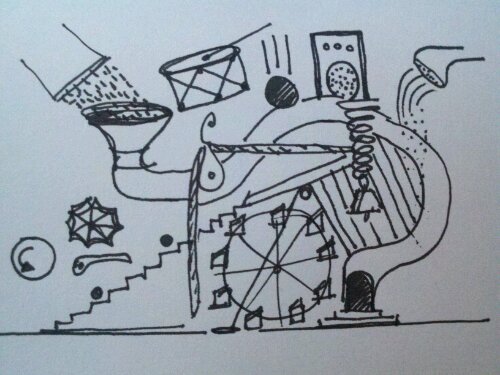
Rube’s Moment

Meetings sometimes go like this:

rubegoldberg

I enjoy the back and forth – the exchange of ideas and building something together.  That’s part of the joy of what I do for a living.  But sometimes, in the middle of the glowy creation phase, you get a flash of perspective and wonder “What exactly are we creating here?”  But you press on, because building something together is messy.

Sometimes along the way, there’s a pivot point in the process when everything changes.  You’re in the flow, everyone’s jamming along, the problems are cropping up and you’re following them down the chute, up the ramp, around the tunnel and then, suddenly, someone pulls that innocent looking lever on the wall and “wham!” the entire contraption changes course and you think “woah now!  Didn’t see that one coming….!”

Rube Goldberg got it.

Life is a crazy, unpredictable mess, but we do our best, draw up good plans, knock our heads together and sometimes the whole thing works in beautiful, wonderful ways.

And sometimes it falls apart and we pick up the pieces and start over again.

The Inbox as Chinese Water Torture

image

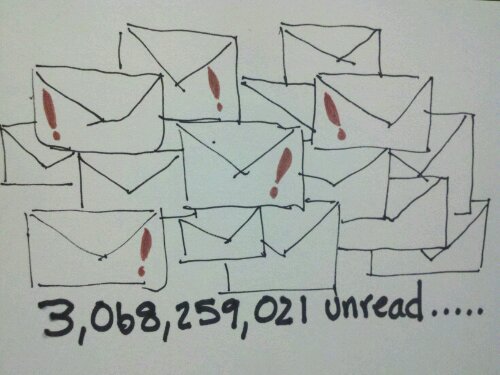
I’ve never actually had more than three billion unread emails, but close, pretty close.

It started so innocently….first one, then a few more, that thrill that you were needed,  you were connected, something exciting  was going on in your inbox.  Then – drip, drip, drip – they just kept on coming.  Daytime, night, weekends, vacation – drip, drip, drip.  And what seemed good or useful kept piling on until the Pavlovian reaction is less teenager-in-love-thrill and more make-the-torture-stop.

There was a point at the three-quarters way mark of a huge project last year that I actually did have 2,277 unread emails in my inbox.  Not three billion, but close, pretty close.

The first time I sat down to send an email, I had an address and a vague idea of what email was, but I had nobody to send a message to except my friend sitting at the terminal next to me.  We spent about 10 minutes there then headed out for food, coffee, people, something real.  I feel like I’ve been through the cycle of not having a use for email to email becoming virtually useless.  The important stuff is buried in the flood of newsletters, cc’s, people trying to schedule meetings through conversation instead of calendar, and the general chaos of people punting in the general chaos  that has more in common with a multi-team global soccer game with no rules than with actual communication.

Wikipedia lists “information overload” as the third problem with email (higher than spam, lower than limited attachment size).  So, what do we do?

In Germany, some lucky dogs at VW have their email blocked during non-work hours.  I think that’s better in some ways than trying to train ourselves to ignore, unplug, and ditch the habit between certain hours – but it’s really ignoring the real problem.

Email has become, in my opinion, fairly worthless but we lack a coherent alternative.  Maybe.  I see people opting out altogether (just a few brave pioneers, mind you) but maybe that’s the wave of the future.  Want to talk?  Pick up the phone.